Hongniang Chooses Revolution
1 2025-07-10T13:24:34+00:00 Jason Wang d86f87879d5d86129032e80721c14eb51cf319fb 1 1 Clip 3: Hongniang Chooses Revolution. plain 2025-07-10T13:24:34+00:00 The film on Bilibili. Jason Wang d86f87879d5d86129032e80721c14eb51cf319fbThis page is referenced by:
-
1
2025-05-03T20:40:32+00:00
Crimson
红娘 (1976) 39 Beijing Opera Film plain 2025-07-10T13:28:10+00:00Beijing Opera Film
Director: Chen Fangqian 陈方千LINK TO THE FILM
- The film with Chinese (simplified) and English subtitles on Bilibili.
INFOMATION
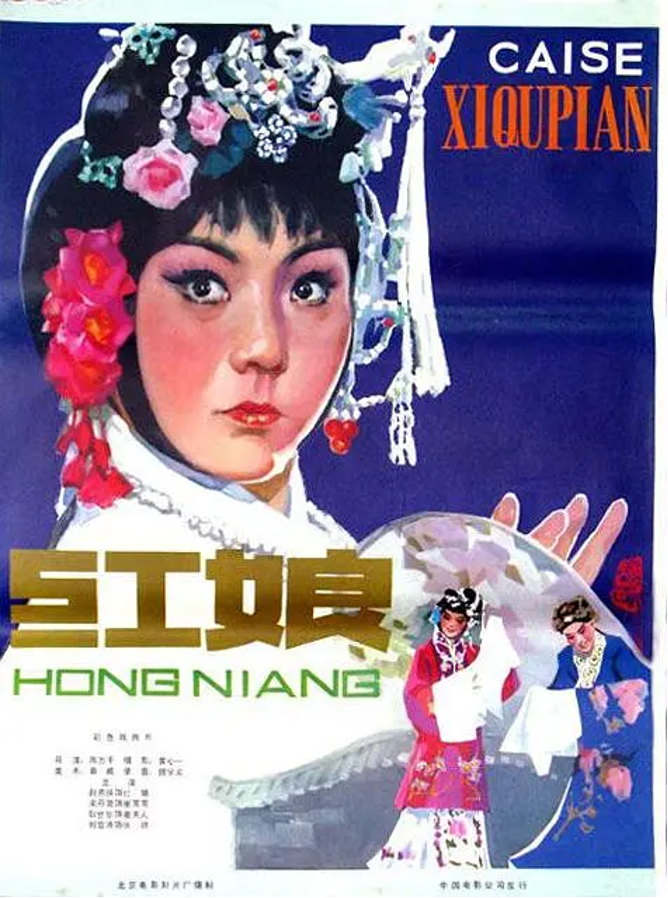
- Title: Hongniang (Crimson) 红娘
- Year: 1976
- Genre: Beijing Opera Film
- Director: Chen Fangqian 陈方千 (1920-1985)
- Troupe: Beijing Opera Troupe (Beijing jingju tuan 北京京剧团)
- Cast: Zhao Yanxia 赵燕侠 (as Hongniang 红娘), Song Danju 宋丹菊 (as Yingying 莺莺), Geng Shihua 耿世华 (as Madam Cui 崔夫人), and Liu Xuetao 刘雪涛 (as Student Zhang 张生)
- Producer: Beijing Film Studio (Beijing dianying zhipianchang 北京电影制片厂)
- Language: Beijing Opera stage language with Mandarin subtitles
- Duration: 98 minutes
INTRODUCTION
The Cultural Revolution was a tumultuous time in the early years of the PRC that greatly altered the political and cultural environment of the nation. Chinese opera was not exempt from these changes and was targeted as an art form that inappropriately romanticized the old, feudal culture. By the 1970s, the central party's belief regarding art was that all art is inherently political and represents the interests of a class (Mackerras 1970). Thus, the party recognized that the conventions of opera had to be modified to act as propaganda in its favor and all productions needed to center around the interests of the workers rather than that of feudal landlords, wealthy merchants, or other members of the bourgeois elite.
The political ideology of the 1970s favored the idea of dualism within Mao Zedong thought. This dualism entailed the philosophy of the “two lines,” (liangtiao luxian 两条路线) with one line representing the party, the proletariat, as well as revolutionary and Mao Zedong thought, and the other line referring to the bourgeoisie, feudal practices, and reactionary thought. The party believed that the two lines were representative of the class struggle, and were therefore in perpetual conflict with each other, and that only one side would prevail. In other words, the emphasis on the two lines meant someone or something was either for the proletariat and against the bourgeoisie, or against the proletariat and for the bourgeoisie. Consequently, in the Maoist view, all art was deemed either beneficial or detrimental to the revolution without allowing for the possibility of apolitical or harmless entertainment (Mackerras 1970). To remodel Chinese opera within this framework, one of the major undertakings was censoring and rewriting operas with reactionary content or bourgeois sympathies. Any content that was considered reactionary was labeled as “yellow,” including anything alluding to sex (Liu 2021).
Despite Chinese opera deriving from the old culture of “feudal China”, many Maoists (including Mao himself) were patrons of the art form and thus made efforts to reconstruct it as a part of the proletarian line. According to Maoism, this entailed portraying heroes as workers, soldiers, or peasants, taking part in revolutionary activity, and the property-owning class as objects of ridicule and attack, as anything more could generate sympathy for the bourgeoisie and serve in their favor (Mackerras 1970). To serve as effective revolutionary propaganda, Mao also favored romanticism and idealism over realism in these new stories and retellings. Other than the shift in thematic elements, the basic conventions of Chinese opera like the music, singing, and movement were mostly kept intact. These components came together to shape an example of revolutionary opera and a rejection of traditional themes in theater.
The stage opera film, Crimson (1976) was developed and eventually released in 1976, the final year of the Cultural Revolution. In terms of its themes, Crimson fits into the mold of a revolutionary opera, particularly as it addresses class struggle along a system of the “two lines.” For one, as Crimson valorizes a maid, it simultaneously villainizes Hongniang’s madam, Madam Cui. Interestingly, an acclaimed female impersonator (nandan 男旦) , Geng Shihua 耿世华, plays Madam Cui. Such a casting choice boosts the rendition’s authenticity as a pre-revolutionary opera, but also serves to ridicule the character in that role. For another, since Crimson focuses on the maid instead of the couple, references to sex and sexuality are toned down to mere euphemisms and innuendos. Another strategic casting choice underscores the polarity of the two lines. Prior to 1949, Zhao Yanxia 赵燕侠, the actress, who plays Hongniang, had made a name for herself as a woman warrior (wudan 武旦) (Liu 2021). Hence, Zhao’s performance had overtones of a martial sensibility. These adjustments, while seemingly slight, align the production with the two-line ideology of art. Below, we will explore how the careful framing of the plot to foreground working class interests and Mao Zedong thought through a classic tale from “feudal China” that was believed to already contain a major anti-feudal theme.PLOT SUMMARY
Crimson is a Beijing opera film adaptation of The Story of the Western Wing by Wang Shifu and follows a similar plot. Zhang Junrui, a scholar on his way to take the imperial examinations, stops at the Temple of Universal Salvation. When he encounters Yingying, he is immediately lovestruck and decides to stay to pursue her. Student Zhang has the chance to win Yinying’s love when his stay is interrupted by bandits and Yingying’s mother, Madam Cui, promises that anyone who can come up with a plan to drive them away will be given Yingying’s hand in marriage. However, after Student Zhang succeeds, Madam Cui breaks her promise. Heartbroken, Student Zhang turns to their maid Hongniang for assistance. Although Madam Cui continuously attempts to thwart the romance between Student Zhang and Yingying, Hongniang cleverly works around her and eventually outsmarts Madam Cui, forcing her to allow the young couple to be together.THEME: The Western Wing as Revolutionary Opera
Before Hongniang can take the lead as the film’s revolutionary hero, it first establishes the reactionary villainy of Madam Cui. Madam Cui is not considered a main role in any version of The Western Wing, but Crimson takes pains to diminish her into a flat character, who comes off as old fashioned, bitter, and unscrupulous. Midway through the film, Hongniang comes to occupy the role of the main character; meanwhile, the movie utilizes Student Zhang’s role as a sort of sidekick to Hongniang. In doing so, it demonstrates some class solidarity through the student and worker collaborating to overcome the tyranny of the old culture as embodied in Madam Cui. As a result, Student Zhang and Yingying’s romance is minimized in favor of showing the development of Hongniang and Student Zhang’s relationship as they work together toward that goal. The amount of time the plot spends on this duo also conveniently cuts down the amount of screen time available for some of the original romance that made The Western Wing controversial long before the 20th century. Keenly aware of the accusations of performing “yellow content” that had previously been levied against her in the 1950s and 1960s, Zhao Yanxia knew how to be very guarded when acting the potentially suggestive role of Hongniang (Liu 2021).Scene 1: Madam Cui: The Unsympathetic Widow
The film introduces Madam Cui as a character beholden to a feudal, anti-revolutionary ideology. Although this scene takes place at a ceremony for Madam Cui’s late husband, the movie does not depict her as a sympathetic grieving widow. Upon learning of Student Zhang’s devotion to his parents, Madam Cui demonstrates her approval and observes that Student Zhang is a filial son. This establishes that Madam Cui subscribes to Confucian ideology, a relic of the so-called “old culture.” Her anti-revolutionary dogma is then further emphasized when she scolds Student Zhang for suggesting that he will also offer sacrifice for her husband, as it would be inappropriate since they are not family.Scene 2: Madam Cui Breaks Her Promise
Madam Cui promises that whoever can turn away the rebels attacking the monastery is entitled to have her daughter’s hand in marriage. When Student Zhang asks Madam Cui if she is sure about her promise, she assents. When Student Zhang’s plan to repel the rogue troops is successful, so he, Yingying, Hongniang, and the audience are all under the impression that Yingying is promised to be his wife. That is, until the celebratory banquet when Madam Cui proves that she is not only untrustworthy, but also manipulative.
Student Zhang struggles to accept that Madam Cui would break her promise and insists that he is her son-in-law now. In response, Madam Cui uses the excuse that before her husband died, they arranged for Yingying to marry her nephew, so she offers Student Zhang dowry gifts for him to find another girl to marry and makes it clear he is disposable to her when it is no longer convenient to have Student Zhang around. Even when Student Zhang stands up for himself, Madam Cui disingenuously insists his arguing is a sign that he is drunk and ignores him.
From the audience’s perspective, this scene cements Madam Cui as the evil force getting in the way of righteous and revolutionary young love. After all, Madam Cui’s primary excuse for not following through on her word is the marriage she already arranged for Yingying growing up, driving home her commitment to the feudal practice of arranged marriage. Along with her conniving nature and the exclusion of any sympathetic details, the portrayal of Madam Cui as a one-dimensional villain fits into the ideology of the two lines, ensuring that any bourgeois or reactionary characters are portrayed as the enemies of the proletariat. This is further illuminated by how Madam Cui’s villainy acts as a foil to her heroic maid, Hongniang.Scene 3: Hongniang Chooses Revolution
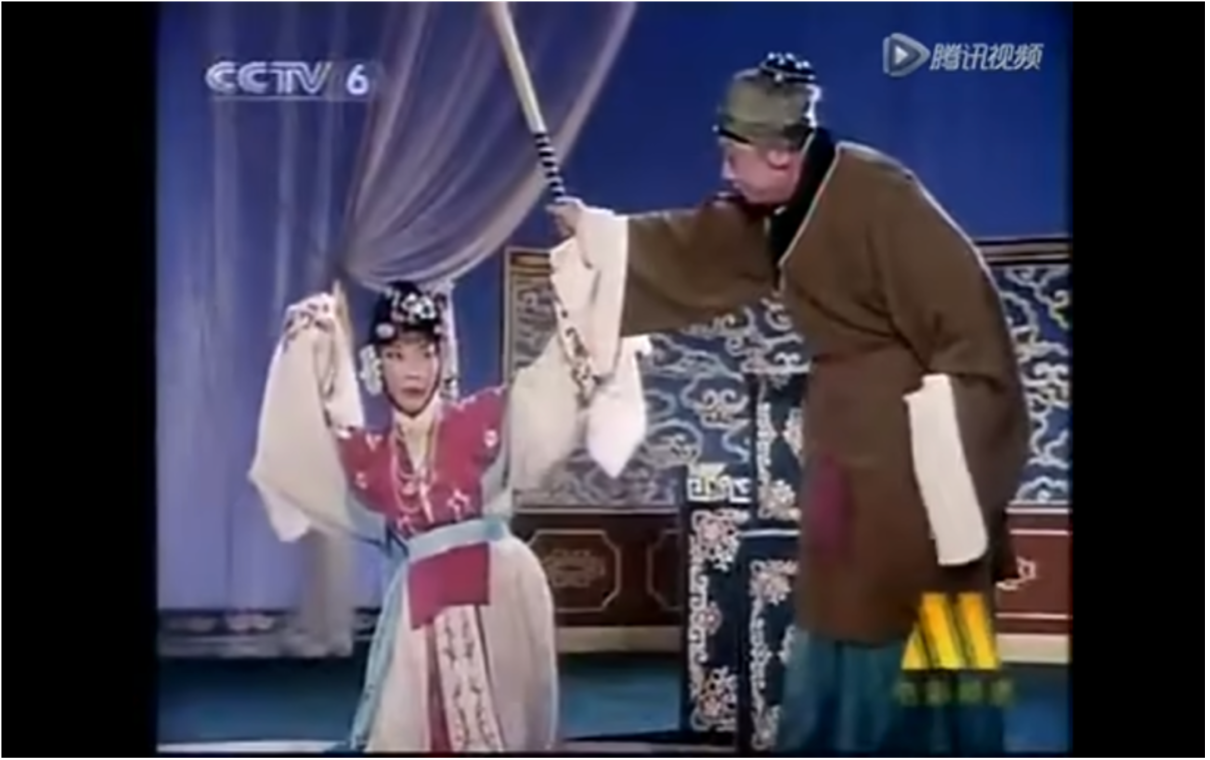
After Hongniang witnesses what she knows to be an injustice to Student Zhang and Yingying, she steps up as the revolutionary protagonist and takes a stand against her mistress. After that turning point, the plot focuses on Hongniang.
Signaling the active role she begins to take, Hongniang demonstrates her superior moral compass and criticizes Madam Cui for her selfish and deceptive behavior. Student Zhang recognizes that Hongniang is in a unique position of power as a maid since she is trusted to be alone with each character, unlike Zhang, and go through the monastery unaccompanied, unlike Yingying. As a consequence, he begs Hongniang to help unite him with Yingying. Hongniang does not quite believe that she could possibly help a scholar when she is illiterate, but Student Zhang convinces her that scholars can only read or write and do not possess the same abilities as her. Freshly empowered by Student Zhang’s words, Hongniang comes up with a plan to help the couple correspond by combining her resourcefulness, courage, and determination with Student Zhang’s knowledge. In this way, she steps into her role as a fearless revolutionary with agency. In this context, she embodies a crucial component in applying Mao Zedong thought to art. In the revolutionary view, Hongniang has traditionally been denied agency as a maid who has to abide by the whims of her mistress, but by taking ahold of her agency through her own decisions, she becomes emblematic of the idealized proletariat to relay a propagandized message of class struggle. Hongniang is the key to shaping the story to be in the interest of the working class, especially when comparing her to Madam Cui.Scene 4: Hongniang and Student Zhang Work Together in Solidarity
Although this scene is ostensibly presented as an opportunity for Student Zhang and Yingying to spend time together, it instead becomes about Hongniang and Student Zhang working together, one of many such instances throughout the film. Immediately, Hongniang shows where her loyalties lie by lying to Madam Cui about the noise Student Zhang makes climbing over the wall in order to shield him. Not only does Hongniang’s lie protect Zhang, it also spurs Madam Cui to leave out of fear. Yingying asks Hongniang to bring over a game, creating an opportunity for Hongniang to bring Student Zhang to Yingying. To illustrate their camaraderie, Hongniang literally covers for Student Zhang by hiding him behind a game board in order to allow him to sneak closer to Yingying, something Hongniang and Zhang must be in sync for, emphasized by the brief dance routine they perform together.
Hongniang’s efforts to bring the couple together do not cease despite the challenges they encounter, and the solidarity she builds with Student Zhang becomes one of the highlights of the film. This happens to fit with the revolutionary themes since Student Zhang and Hongniang are the closest to the proletariat, with Hongniang being a maid and Student Zhang being a scholar with no position or money, and they are both wronged by the feudal notions of Madam Cui.Scene 5: Hongniang’s Revolutionary Victory
The conclusion to the film highlights the reactionary brutality of Madam Cui and the cunning resourcefulness of Hongniang, the representatives of the bourgeoisie and proletariat respectively. When Madam Cui discovers that her daughter and Student Zhang have been seeing each other behind her back with Hongniang’s assistance, she confronts Hongniang in a final stand-off. Madam Cui cruelly scolds and beats Hongniang, threatening to turn her over to local authorities for ruining her family, but clever Hongniang finds a way to turn the situation around and outsmarts Madam Cui. Hongniang wields her circumstances in her favor yet again and builds a case against Madam Cui that she brought about her own demise, as the audience is already aware of, through her misdeeds. Eventually, Madam Cui gives in, so long as Student Zhang passes the imperial exam. This scene represents the pinnacle of class struggle as a central theme due to the characterizations of Madam Cui and Hongniang as each other’s foils. Madam Cui, as the bourgeois oppressor, has a monopoly over violence and gleefully wields it through the stick she beats Hongniang with; but Hongniang, though she does not possess disciplinary power in this situation, is able to use her cunning and sense of justice to defend herself and the young couple, scoring a victory over the feudal system of the time. Hongniang’s success in the climax exemplifies an idealized version of a revolutionary, who seizes a moment to dismantle reactionary forces. Hongniang has the last word with some advice for Student Zhang to remain faithful and return in triumph.WORKS CONSULTED: CLICK TO EXPAND/COLLAPSE
Liu, Siyuan. Transforming Tradition: The Reform of Chinese Theater in the 1950s and Early 1960s. Ann Arbor, MI: The University of Michigan Press, 2021.
Mackerras, Colin. “Chinese Opera after the Cultural Revolution (1970-72).” The China Quarterly 55 (1973): 478–510.
AUTHOR
Olivia Bobak