Chinese Theater CollaborativeMain MenuAboutResources for PlaysDescription of pageMedia Types and Opera StylesHow to Teach With Chinese Theater Collaborative
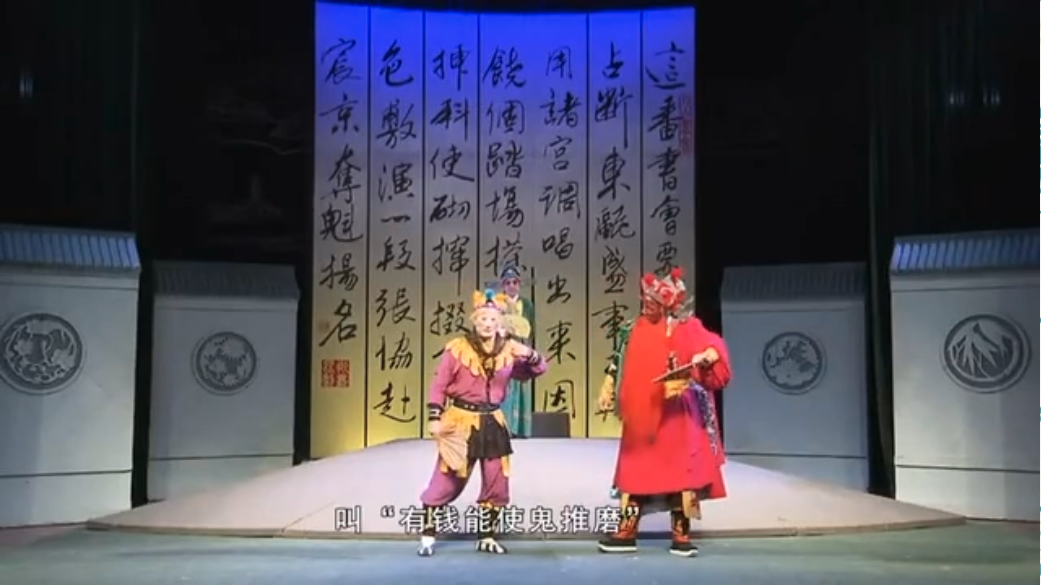
Screenshot from Top Graduate Zhang Xie (2017)
1media/MediaType_RecordedPerf_1_thumb.png2025-12-23T20:04:41+00:00Jason Wangd86f87879d5d86129032e80721c14eb51cf319fb11Fig. 1: Feeling exploited, Little Demon and Divine Judge use jokes to complain.plain2025-12-23T20:04:41+00:00The Yongjia Kunju Troupe 永嘉昆剧团 performance of Top Graduate Zhang Xie found on Bilibili. Credit: Screenshot by CTC Project Team.Jason Wangd86f87879d5d86129032e80721c14eb51cf319fb
This page is referenced by:
1media/CTC_StaticBG.png2021-11-22T17:21:32+00:00Recordings of Live Performances of Traditional Chinese Theater20plain2025-12-30T20:35:40+00:00 We feature recordings of live performances of traditional Chinese theater (also known as "Chinese Opera"). In this scenario, the live performance takes place in a designated theatrical space with a live audience. The liveness of the performance is an important facet of the theatrical communication. The recording of the performance is often an ancillary aspect of the production.
Such live productions usually take place with the performance traditions of particular regional styles of Chinese theater. Some of the most well-known styles are Kun Opera (kunqu 昆曲), "Peking/Beijing Opera" (jingju 京剧), Cantonese Opera (yueju 粤剧), Huangmei Opera (huangmei diao 黄梅调) and Shaoxing Opera (yueju 越剧). Some of these forms have performance histories going back to the sixteenth century (Kun Opera), other originated in the nineteenth century (Peking/Beijing Opera; Cantonese Opera), other still are neo-traditional forms dating to the twentieth century (Huangmei and Shaoxing Opera). Moreover, currently, many of these traditions have particular different teaching lineages embedded within them, often originated by a particularly famous twentieth-century performer.
This site makes the play the central point of departure, not a particular style or substyle of Chinese theater ("opera"). Some plays are more important in some regional forms than in others. Accordingly, in our choice of live adaptations, we are not exhaustive, but instead selective.
MODULES ON LIVE PERFORMANCES OF TRADITIONAL CHINESE THEATER