Liu Mengmei sees Du Liniang's resurrection
1 media/Mudanting_2009_TV_8_thumb.png 2023-12-07T15:46:27+00:00 Julia Keblinska 8a3e8d98762f87c0579d0d96f52acf9bb4742f98 1 1 Fig. 8: When the flower deities bring Du back to life, the scene is shot from Liu’s side and a perspective of a third-person audience. plain 2023-12-07T15:46:27+00:00 The drama on Bilibili.Credit: Screenshot by author. Julia Keblinska 8a3e8d98762f87c0579d0d96f52acf9bb4742f98
This page is referenced by:
-
1
2023-08-08T15:46:38+00:00
The Return of the Soul at the Peony Pavilion
牡丹亭還魂记 (2009) 89 plain 2025-07-22T18:41:06+00:00Yue Opera TV Drama
LINK TO THE TV DRAMA
- Link to Part 1 on bilibili (with simplified Chinese subtitles).
- Link to Part 2 on bilibili (with simplified Chinese subtitles).
INFORMATION
- Title: The Return of the Soul at the Peony Pavilion 牡丹亭還魂记
- Year: 2009
- Directors: Tao Hai 陶海 and Wei Xiangdong 韋翔東
- Cast: Jin Jing 金靜, the personal disciple of Qi Yaxian 戚雅仙, the founder of the Qi School 戚派of Yue Opera (as Du Liniang 杜麗娘); Wang Jun’an 王君安, the inheritor of the Yi School 尹派 of Yue Opera that was founded by Yin Guifang 尹桂芳 (as Liu Mengmei 柳夢梅); Sheng Shuyang 盛舒揚, the inheritor of the Fu School 傅派 of Yue Opera founded by Fu Quanxiang 傅全香 (as Chunxiang 春香).
- Producer: CCTV’s Central Studio of News Reels Production 中央電視台新影製作中心 and Shanghai Jing’an Yue Opera Troupe 上海靜安越剧院
- Language: Chinese
- Duration: Part 1: 1:48:50; Part 2: 1:41:16
INTRODUCTION
Director Tao Hai started out as a radio host and then became a Yue Opera film director. One of his earliest film credits was a Yue Opera rendition of The Dream of the Red Chamber (Hongloumeng 紅樓夢 2007). For the 2009 production of The Peony Pavilion, he teamed up with Wei Xiangdong. Between 2002 and 2005, Wei was a host for the Shanghai TV Drama Channel 上海電視台戲劇頻道. From 2005 to 2015, Wei began to work at CCTV’s Central Studio of News Reels Production as host, director, and producer, which is when he cooperated with Tao to produce the CCTV adaptation of The Peony Pavilion in 2009.
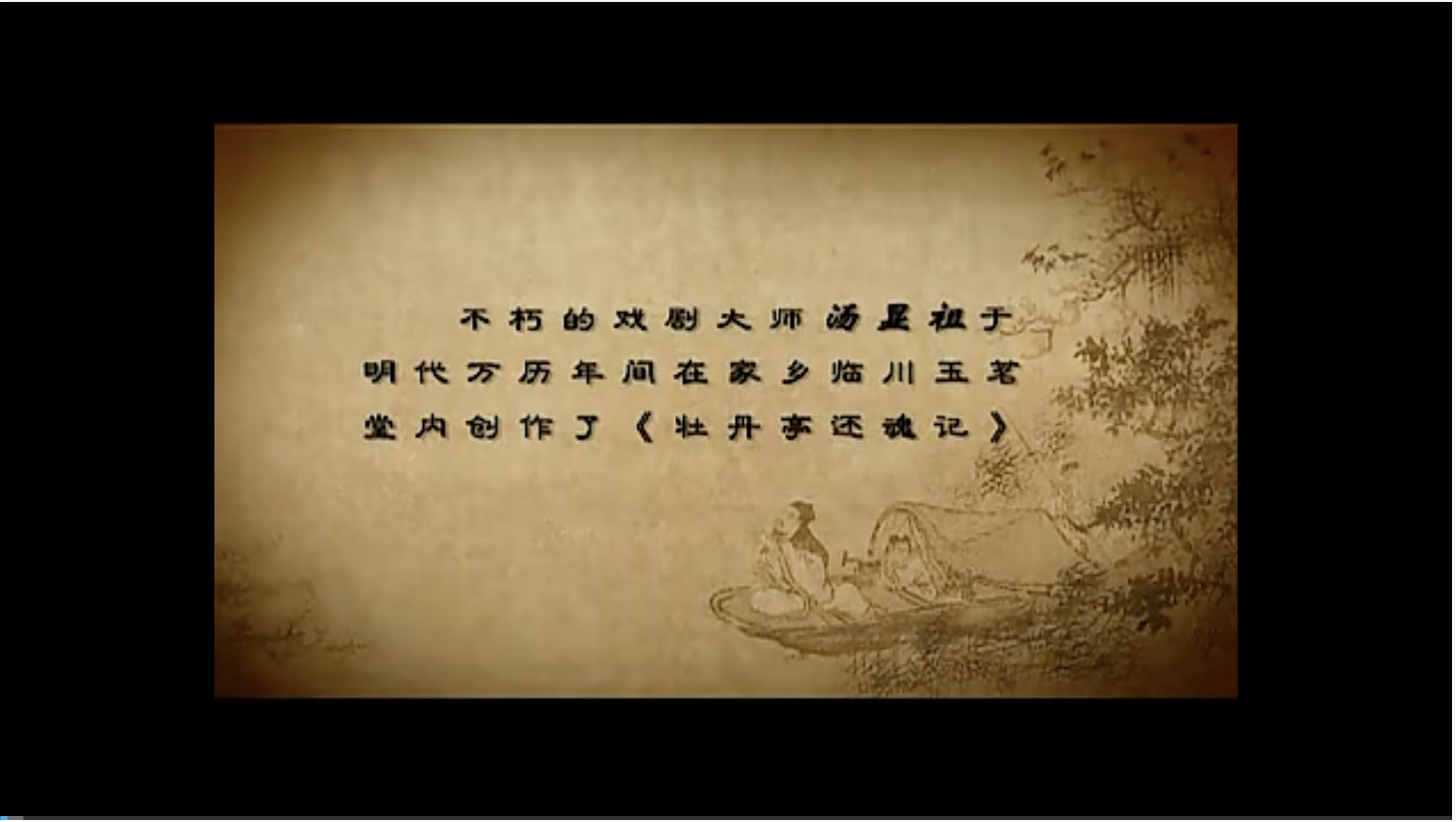
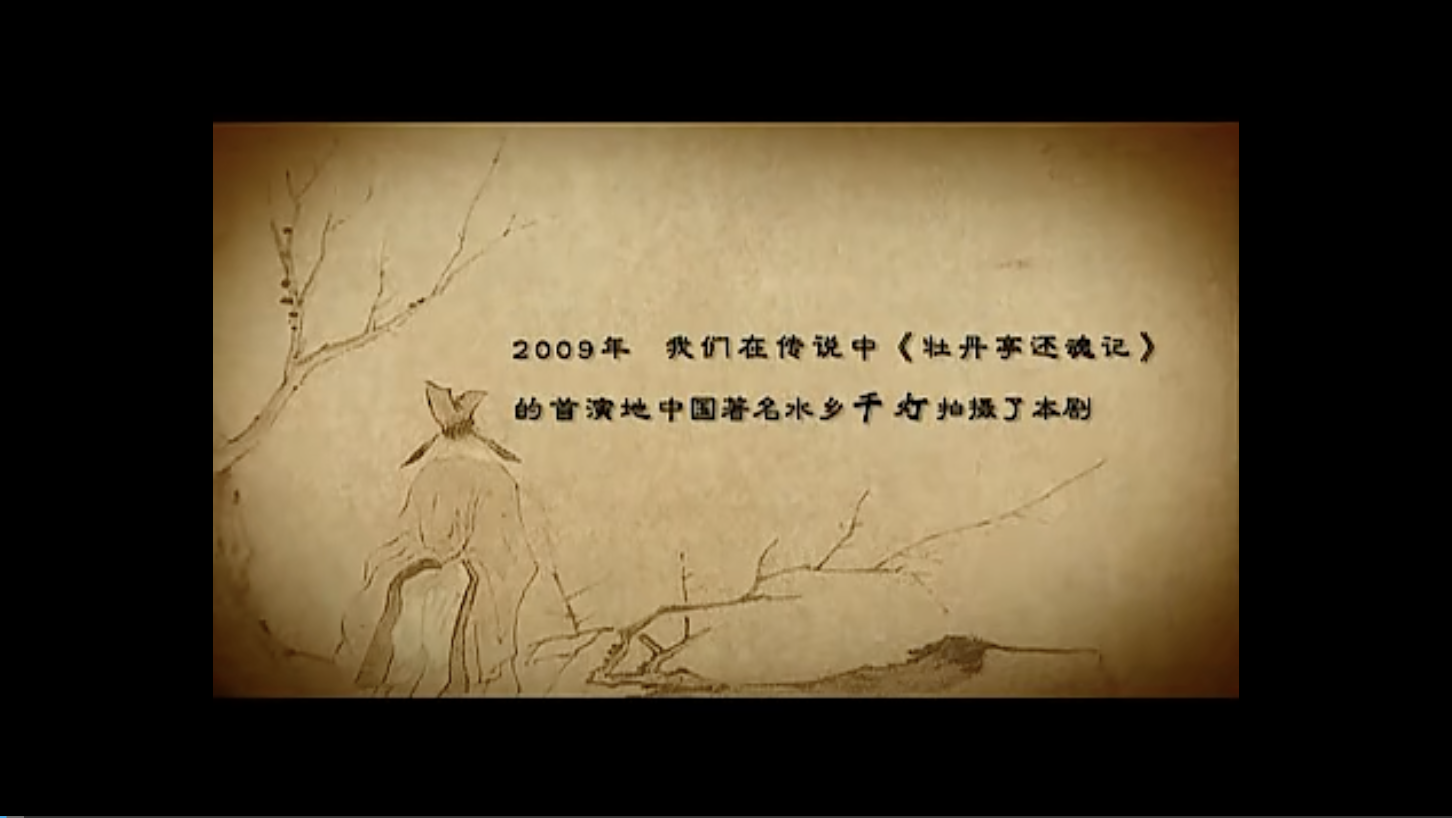
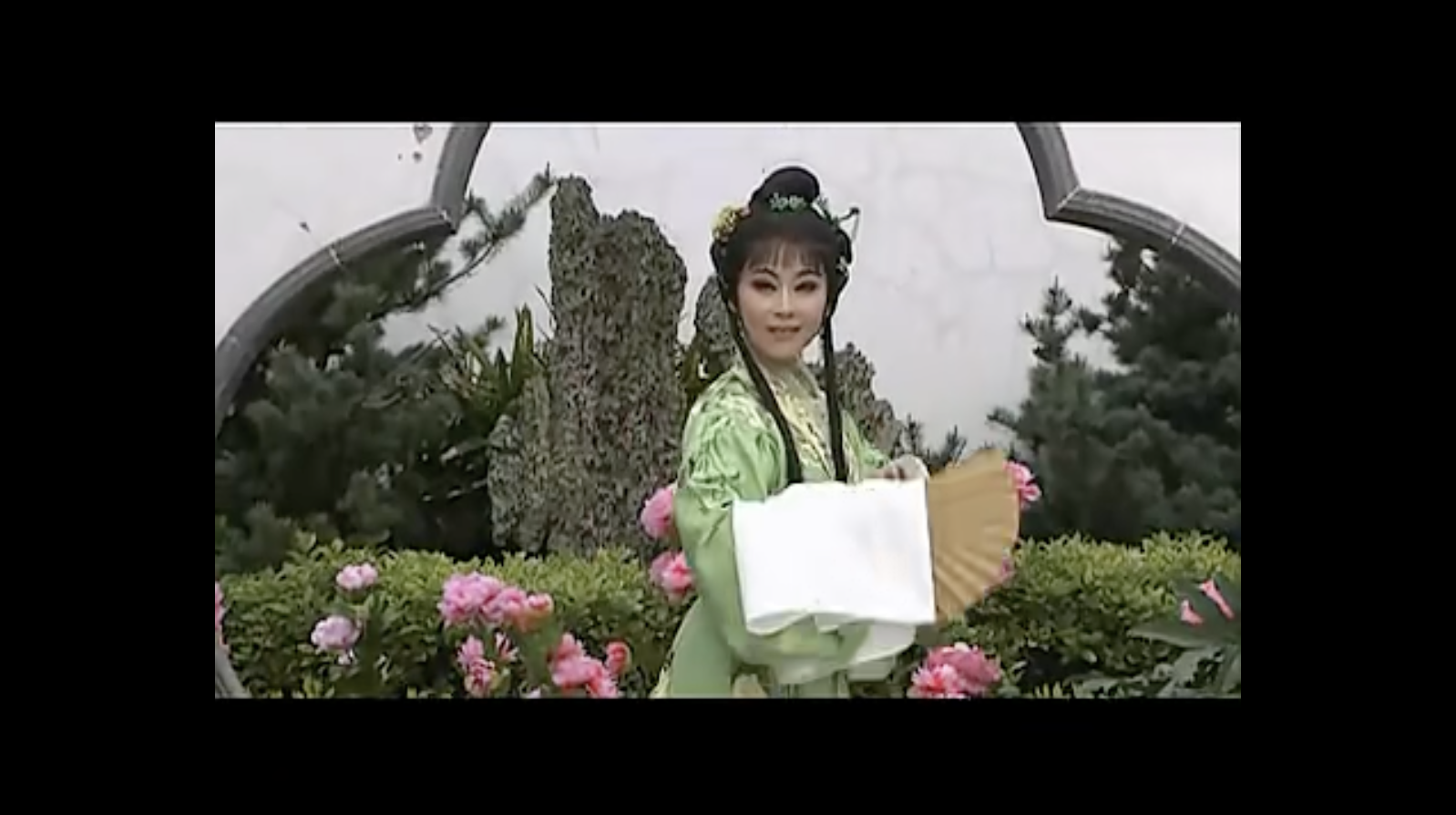
This TV adaptation is divided into two parts. The introductory segment of each part foregrounds Tang Xianzu 湯顯祖 (1550-1616), the original author of The Peony Pavilion, as well as the site of the staging. A title card that opens each episode reads: “The immortal master of Chinese drama, Tang Xianzu, wrote The Peony Pavilion in his hometown Linchuan 臨川, Jiangxi Province 江西 during the Wanli 萬曆 era (r. 1573-1620)" (see fig. 1). A second title card immediately follows and reads: "In 2009, we [CCTV and Jing’an Yue Opera Troupe] shot this TV drama in China’s famous Watertown, Qiandeng 千燈, Zhejiang Province 浙江. Qiandeng, according to anecdotes, was the first place where The Peony Pavilion was publicly performed" (see fig. 2). Arguably, one possible reason to choose Qiandeng as the shooting location is that the CCTV crew wanted to reproduce Peony Pavilion as if the audience was seeing this play for the first time. This heightened sense of cultural continuity and "liveness," a quality associated with early television, thus blurring the lines between a staged drama, a live broadcast, and a taped program (which this adaptation ultimately is). In terms of the themes underscored by the 2009 adaptation, out of the 55 scenes of Tang Xianzu’s original play, the production selectively includes around 35 that are closely related to the idea of “love (qing 情) that transcends life and death.” However, as will be shown below, despite its proclaimed proximity (both textual and geographic) to the original text, the new rendition also modified the plot in places to best exploit its intermediality, that is, its "televisual staging," combing the attractions of stage performance with the expressive possibilities of television.PLOT SUMMARY
Tang Xianzu’s Peony Pavilion includes 55 scenes that contextualize the love story between Du Liniang and Liu Mengmei within the broader social world that they lived in, including the political situation in the capital and the period's warfare. However, the 2009 CCTV adaptation selectively chooses segments from the first 36 scenes of Tang’s text, focusing on those that are more closely related to the qing 情, or love, between Du and Liu. The main scenes in the CCTV adaptation include Scenes 7 (“The Schoolroom” 闹塾), 10 (“The Interrupted Dream” 驚梦), 12 (“Pursuing the Dream” 寻梦), 14 (“The Portrait” 写真), 18 (“Diagnosis” 诊祟), 20 (“Keening” 闹殤), 24 (“The Portrait Recovered” 拾画), 27 (“Spirit Roaming” 魂遊), 32 (“Spectral Vows” 冥誓), 35 (“Resurrection” 回生), and 36 (“Elopement” 婚走). The selection narrows the scope of the famously long play to roughly three and a half hours.
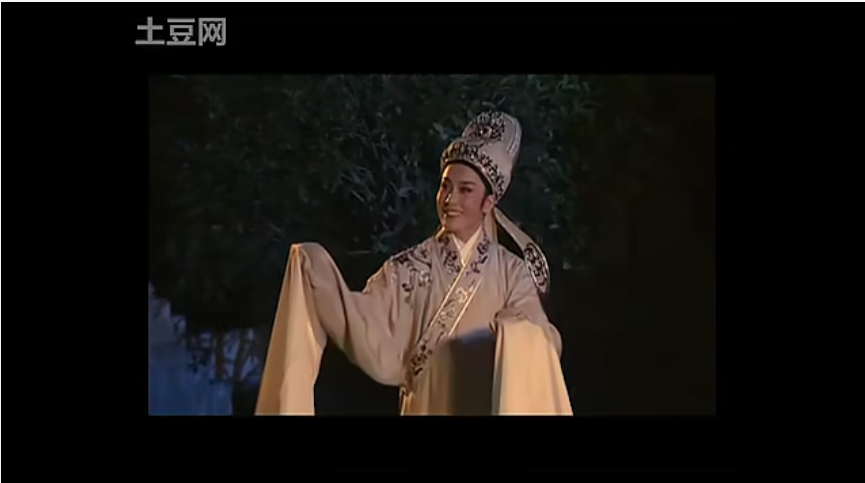
In the CCTV adaptation, Du Liniang (played by Jin Jing 金靜), the daughter of the prefect of Nan'an, falls asleep while wandering in the rear garden. In her dream, she sees a male student, Liu Mengmei (played by Wang Jun’an 王君安), and falls in love with him (see fig. 2). However, after waking up from her dream, Liniang cannot find the student. Due to lovesickness and excessive grief over the loss of her dream lover, Du Liniang dies on the night of the Mid-Autumn Festival. A year later, Liu Mengmei is on his way to find Du Liniang, whom he also encounters in a dream, when he falls ill and faints in front of Du's mansion. He is rescued by Du Liniang's former private tutor and temporarily lives in a remodeled Taoist temple in the rear garden. In the garden, Liu Mengmei finds Du Liniang's portrait in accordance with the scene that played out in their shared dream.
While Liu looks at Du’s portrait and tries to find out who the young lady in the portrait is, Du, whose soul has remained in an ethereal realm thanks to the help of flower deities (花神 huashen), obtains a magic incense with the power to resurrect souls from her mystical benefactors. Du’s wandering soul then appears in human form to meet Liu in the garden. The two recognize each other as the dream lovers. Du then gives the incense to Liu and tells him to light it in front of Du’s grave. Liu Mengmei explains the truth to Du Liniang's father, but the latter does not believe Liu and locks him in the dungeon at home. Du Liniang's maid, Chunxiang, secretly rescues Liu in the middle of the night. They light the soul-returning incense, dig up Du Liniang's grave, and find that Du Liniang has been brought back to life. Du Liniang then marries Liu Mengmei in the presence of Du’s whole family.
The narrative choice to feature a single, shared dream, differs from Tang Xianzu’s original text, in which Du Liniang’s and Liu Mengmei’s dreams are, according to Ling Hon Lam, “temporally set apart rather than articulated as a single shared dream” (Lam, “The Peony Pavilion,” 223). The shared dream heightens the magical and romantic atmosphere of the adaptation, highlighting the lovers' fated union and playing to contemporary tastes.THEME: The Expression of Qing in the Hybrid Medium of Yue Opera TV Drama
Following the genre conventions of opera-related film, this adaptation is an "opera television drama," akin to the "opera film." Unlike a typical "TV drama" (or typical narrative film) which uses classical editing to produce a sense of a "realistic" and self-contained fictional world, The Return of the Soul makes use of the television medium but retains the quality of a theatrical stage. Furthermore, with just two episodes, the adaptation works more like a television "film" rather than a serialized television "drama" with multiple episodes. This module will explore how the media of television and drama interact. As the video clips featured below show, qing is the key in guiding the two main characters’ actions and feelings. However, instead of directly expressing qing through intimate body language (such as hugs and kisses), the 2009 CCTV adaptation highlights the intensity of passionate feeling by showing, how upset one would be if she/he could not have qing. This is to say, by performing the characters’ extreme sorrow, grief, and anxiety when Du and Liu could not meet each other in the real world after their dream meeting, the Yue Opera actresses emphasize the significance of qing in this love story. Though as explained above, this is not a contemporary "TV drama," such an emphasis on melodramatic affect is a common feature of other popular TV fare in China. Moreover, the following video clips also demonstrate that the 2009 CCTV adaptation, as a Yue Opera television drama, uses editing, cinematography, and special effects to complement the expressive performance of qing for television viewers.Case 1: “Pursuing the Dream” (“Xunmeng” 尋夢)
Click to expand/collapse Translation Notes
Chinese subtitles CTC Translation 杜丽娘:登亭观, 依栏望。 Du Liniang: Climbing the pavilion to see [Liu], leaning on the railings to look for [Liu] 杜丽娘:梅边探,柳下寻。 Du Liniang: Searching for [Liu] besides the plum tree, looking for [Liu] under the willows 杜丽娘:书生呀!书生!你在何处啊? Du Liniang: Oh, Student Liu! Student Liu! Where are you now? 杜丽娘:望穿眼,盼断魂,千呼万唤无人应。 Du Liniang: I keep gazing till [my] eyes are strained, longing [for him so] desperately that [my] heart breaks, I call out countless times yet, there is no response from anyone. 杜丽娘:只闻流水潺潺响,花飘叶落风动铃。 Du Liniang: I only hear the murmuring stream; the petals drift and the leaves fall as the wind moves the bells. 杜丽娘:书生呀,书生,你姓什么啊? Hongniang: Cheng Ying: You let them take away the orphan? 杜丽娘:悔不与书生题诗文,悔不与书生问姓名。 Du Liniang: I regret not composing poems with the Student, I regret not asking the Student for his name. 杜丽娘:咫尺天涯无觅处,空余碧潭照孤影。 Du Liniang: No matter whether close at hand or at the end of the world, there is nowhere for me to find [the student], leaving only my lonely reflection in the azure pool.
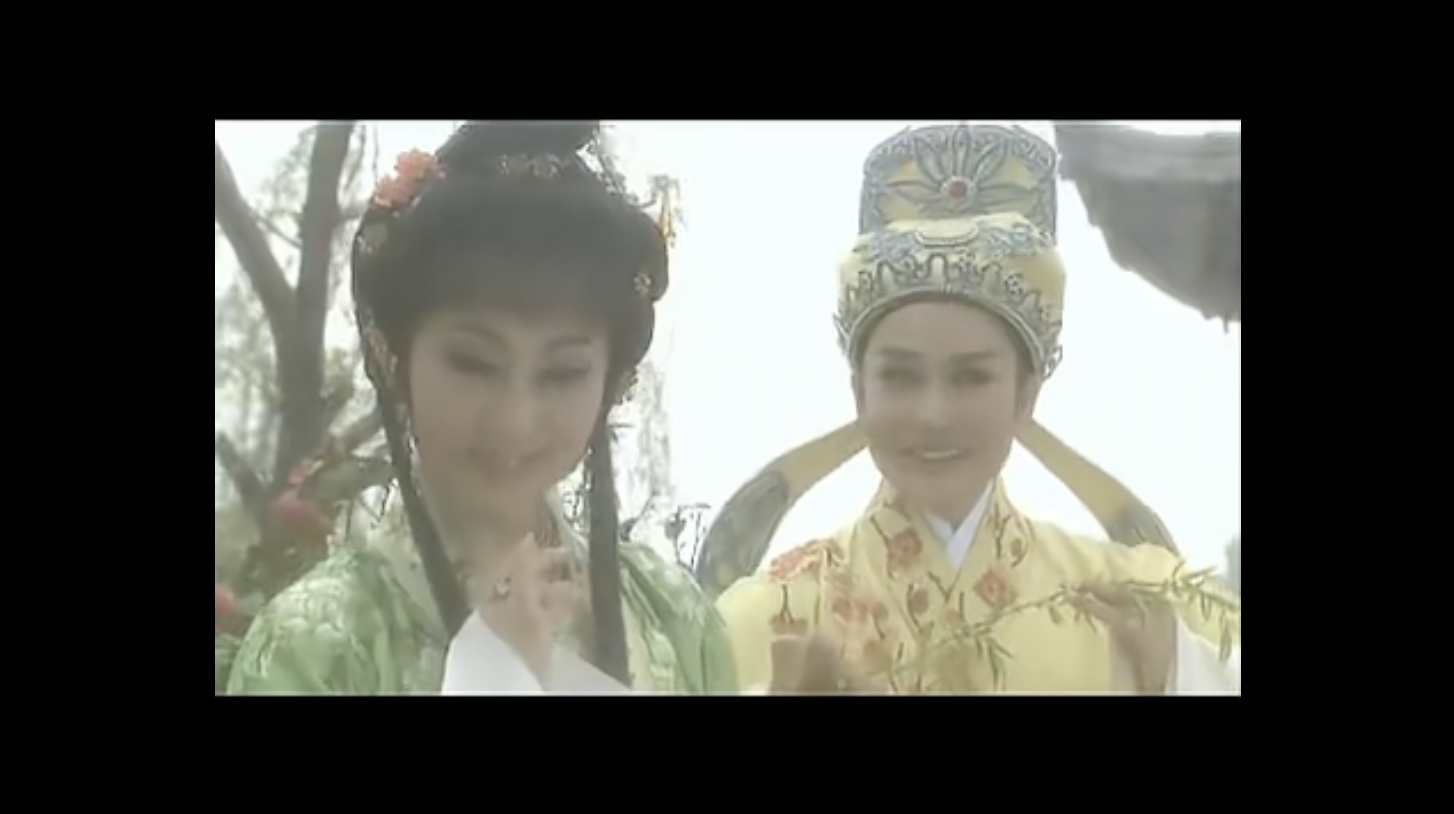
In this sequence, we see Du's second foray into the garden. Du’s father does not allow her to roam around in the rear garden. He believes that the colorful flowers in the rear garden will distract Du from studying (nüshu 女書 , lit. “women’s writing”) and prevent her from being a “fine lady.” However, after Du Liniang falls in love with Liu Mengmei in their shared dream of romance (aiqing 愛情) that unfolds in the garden, Du once again returns to the rear garden to search for Liu, despite her father's admonition. There, Du’s passion (qing) and her desire to see Liu is so strong, as her emotional vocal performance communicates, she conjures a vision of the young man. The CCTV adaptation represents this hallucinatory scene by superimposing a shot of Liu onto a garden scene. This illusion of Liu appears from Du's perspective (see fig. 4). When she first sees him, a shot back to Du the spectator of the illusion shows she is smiling. When the camera cuts back to her point of view, he disappears. In the subsequent close shot of her face, she is distraught to realize that she cannot meet with him.
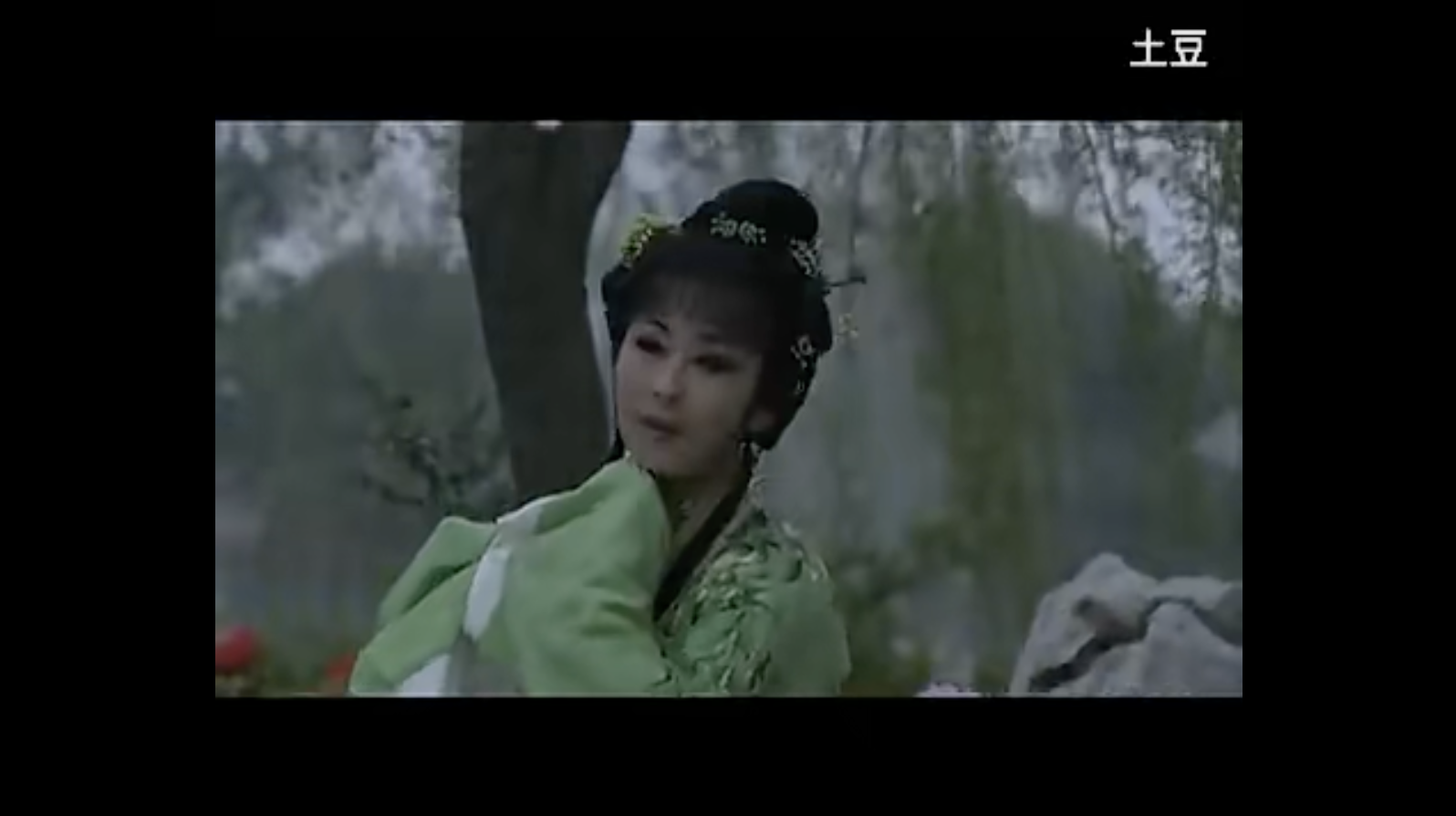
In addition to editing point-of-view shots with a superimposed, illusory shot of Liu, to suggest that the young woman's strong emotion can conjure visions, the CCTV adaptation also implies that the young woman's inconsolable passion can alter atmospheres. Her great sorrow over being unable to reconnect with her lover is expressed through performance skills and the visible atmospheric changes in the environment. On the one hand, after the failed encounter, Jin Jing's performance of Du Liniang is so emotional that the character can barely walk anymore. She staggers around the garden. On the other hand, when Du first enters the rear garden at the beginning of the sequence, it is a sunny day, but once Du feels heartbroken and upset, the weather suddenly becomes windy and overcast (figs. 5 and 6).
The change in weather is not so extreme (no heavy rainstorm, lightening, or thunder) as to necessitate special effects; yet, as the scene progresses and Du's despair grows, it becomes windy and the sky gets overcast. Nevertheless, the sequence must have been shot on two separate days and edited together to visualize Du’s feelings and emotions through the changes of weather. Despite the sense of liveness and authenticity to the staged production implied in the program's opening sequence, then, the series relies on editing together asynchronous elements to enhance acting performance with atmospheric affect.
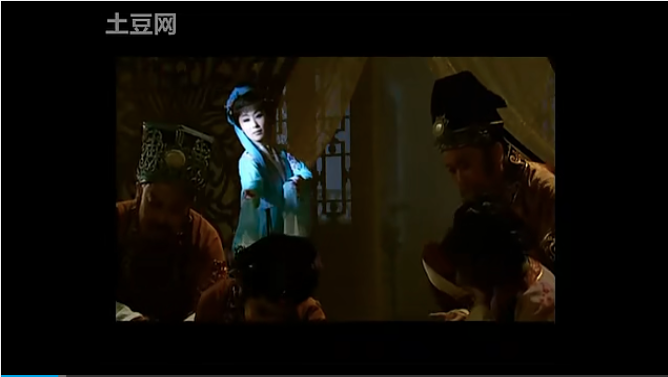
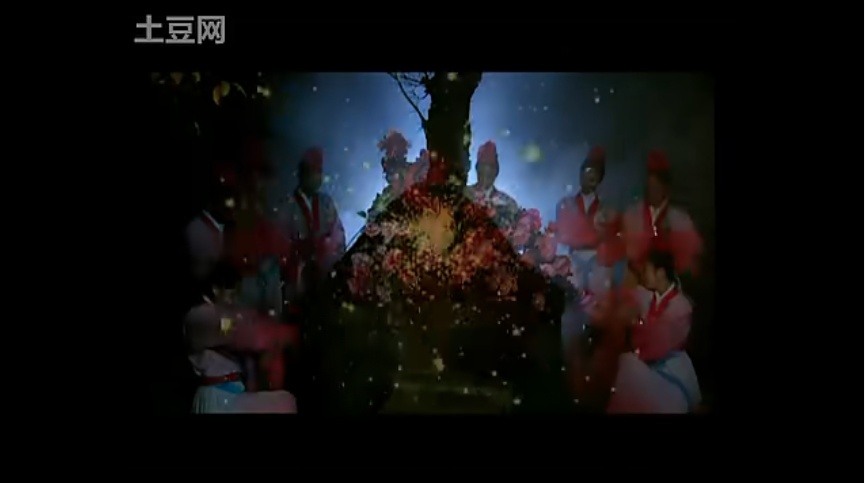
Case 2: “Keening” (“Naoshang” 鬧殤)In this scene, passion (qing) is portrayed as the direct cause of Du Liniang’s death through a gloomy mise-en-scène. After Du’s second visit to the rear garden in the scene of “Pursuing the Dream,” she falls severely ill due to her failure to locate qing in real life. On the day of the Mid-Autumn Festival 中秋節, a traditional festival that is synonymous with idea of family gathering, Du dies due to her great sorrow. As Du’s father points out, after she comes back from visiting the rear garden, his daughter’s feelings are deeply wounded (shangqing 傷情) and lead to her untimely demise. After Du dies, her soul leaves her body and appears behind the other characters, who fill the scene's dark foreground (see fig. 6). By contrast, Du's soul (played by Jin Jing) is clad in a light blue dress. The televisual adaptation thus uses chiaroscuro lighting to emphasize the central character in this scene (Du’s soul) and the difference between the dead (Du’s face is lit up) and the living (whose faces are hidden in the darkness). We see here that the gloomy atmosphere of the garden occasioned by Du's distress also appears to be the cause of her illness. It has permeated into the house, shrouding the interior space with a heavy darkness that augurs death.Click to expand/collapse Translation Notes
Chinese Subtitles CTC Translation 春香:老爷,夫人,小姐病成这个样子,你们还争些什么呀。 Chunxiang (Fragrance): Master, Madam, my Mistress’s health has taken a drastic turn for the worse, what are you still arguing about. 夫人:女儿,女儿! Madam: My daughter, my daughter! 杜丽娘:爹爹。 Du Liniang: Father. 老爷:儿啊! Master: My child! 杜丽娘:母亲。 Du Liniang: Mother. 夫人:女儿! Madam: My daughter! 杜丽娘:休为女儿怒气动,只怪丽娘罪孽重。 Du Liniang: Please do not get angry with your daughter, simply blame it on Liniang’s grievous transgressions. 杜丽娘:儿死别无求,一事望依从。一枝垂柳三尺土,就在那,牡丹亭畔,芍药栏前,梅花树下埋香冢。 Du Liniang: Your child has no other wish after my death, I only beg for your indulgence in one matter. Please bury me where a willow branch hangs over a three-foot mound, right there, next to the peony pavilion, in front of the balustrades of paeonia, and beneath the plum blossom tree. 众人齐:儿啊/女儿/小姐! Master, Madam, and Chunxiang together: My child/daughter/mistress!
Part 2, 1:36:21-1:37:10
Case 3: “Resurrection” ("Huisheng" 回生)Click to expand/collapse Translation Notes
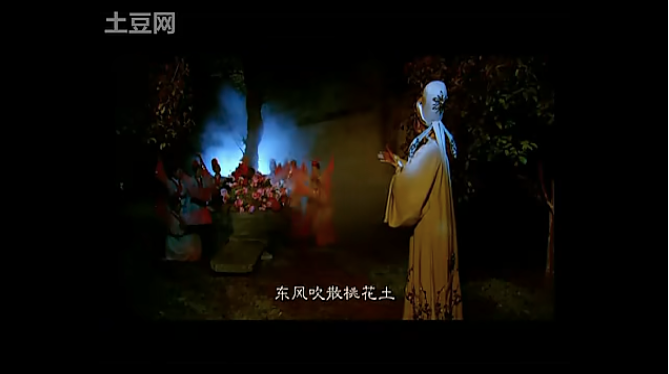
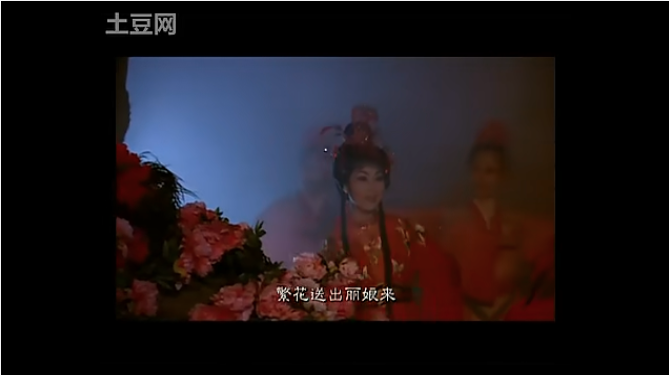
Chinese Subtitles CTC Translation 花神:东风吹散桃花土,繁花送出丽娘来。 Flower deities: The East wind blows away the dirt under the peach blossom, and the blooming brings Liniang [Du Liniang] out [of her grave]. 花神:芳魂一缕归玉体,芳姿不改旧时态。 Flower deities: Her beautiful soul has returned her jade-like fine body, and her beauty remains as the old time [before she dies].
In this scene, Du Liniang's maid, Chunxiang (played by Sheng Shuyang 盛舒揚) and Student Liu light the resurrection incense, dig up Du's grave, and bring Du back to life. Like Du's melancholic death, this miraculous resurrection is also possible because of the devotion of love (qing). First, Du’s soul is still present and available to be resurrected because of her obsessive attachment to her dream lover, Liu Mengmei. Second, Liu faints in front of Du’s family because he, just like Du, is also determined to find the lover he encountered in his dream (and presumably so overcome with passion as to fall ill at the precisely the right spot to later find her). Third, Du’s soul receives the resurrection incense from flower deities who tell her that the way to bring her back to life is to wait until her destined lover ("the one with qing" or youqing ren 有情人) lights the incense. Thus, the deep passion (qing) that both Du and Liu have for each other has a tremendous impact on the plot; when the lover's reciprocal passions are finally aligned in the same place and time, it is qing that eventually makes Du’s resurrection possible. Most importantly, this qing is mutual rather than unilateral: both Du and Liu show their deep love to each other.
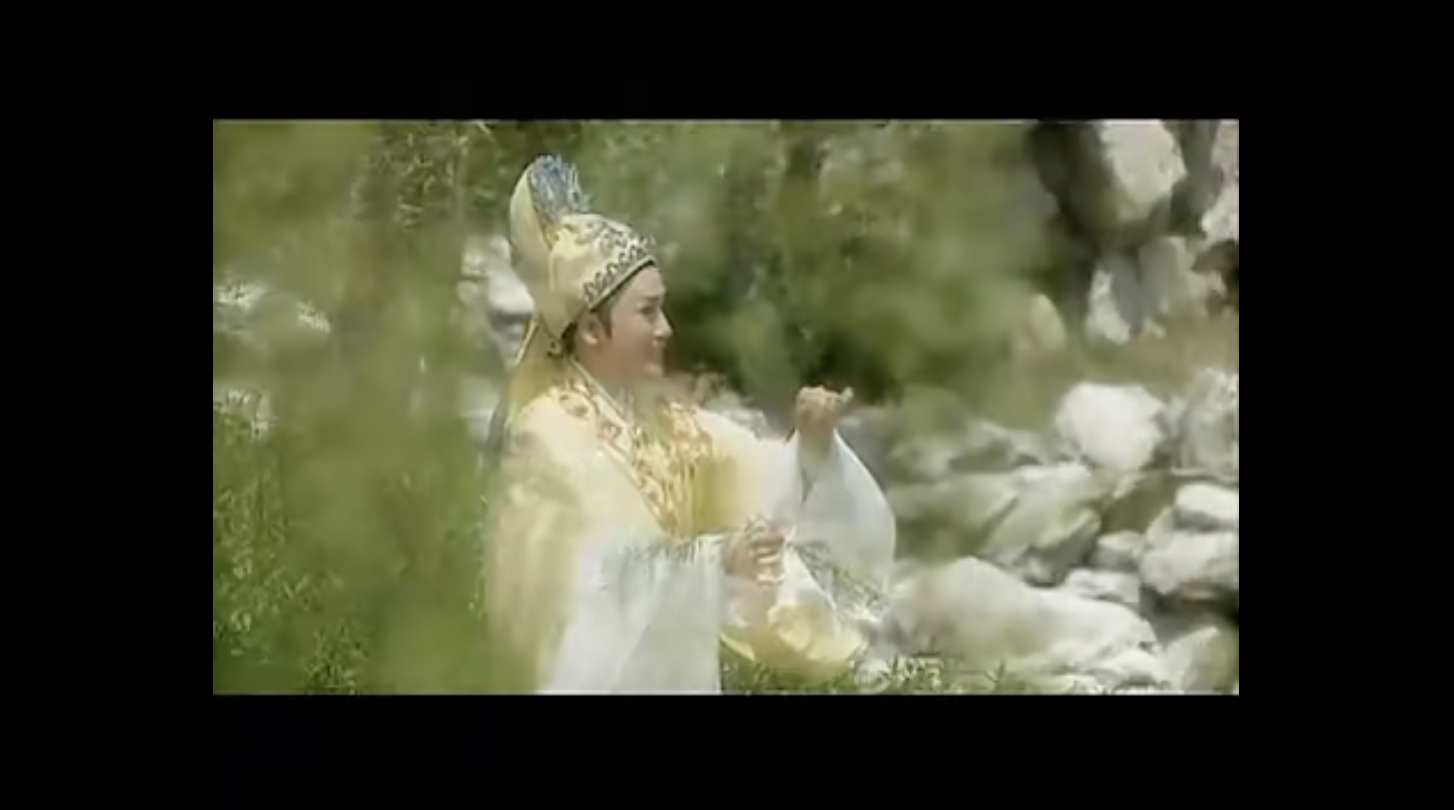
Unlike a traditional stage production, which requires the audience to view the performance on a stage and thus limits possible perspectives, the CCTV adaptation expresses this mutual love between Du and Liu is expressed through editing that opens up the space of the televisual "stage." The camera shifts between shots of Du and Liu, which provides allows television viewers to see both of the protagonists from a frontal perspective, a shot/reverse shot structure that heightens the emotional connection between the two. The camera first provides an over the shoulder shot of Du’s resurrection as seen from behind Liu (fig. 8). A subsequent close shot shows Du seemingly from Liu’s perspective, but her eyes look just past the camera, suggesting this is not exactly a POV shot (fig. 9). A reverse shot from Du’s angle shows Liu in a close shot, but also from a third person perspective (fig. 10). By adopting camera language that underscores the connection between the characters, the CCTV adaptation shows the television viewers what to see "on stage" and and thus shows the mutual qing between these two protagonists by emphasizing the emotional communication between Du and Liu rather than focusing solely on the fact of Du’s resurrection. Because the actors look just past the camera, as opposed to looking head on into the lens, the audience is left just outside of the interaction, we are meant to see the qing but recognize it as nevertheless private.
In this scene, the CCTV adaptation also uses special effects that emphasize the flower deities as “divine goodness" who allow for Du's resurrection by providing incense. In a traditional stage performance, the deities’ identity is highlighted though their appearance (makeup and clothing), acting (body language), and music. Some modern operas might adopt stage props such as smoke and light. In the CCTV adaptation, a flare sparkled on the screen and the flower deities appear suddenly in front of Du’s grave. Such an abrupt appearance relies on editing and is much harder to achieve in a stage production. In general, the adaptation combines common elements of modern stage design (like ethereal smoke) with the tricks of TV production to achieve the hybrid aesthetic of an "opera television drama."
Part 2, 1:38:09-1:38:50
Conclusion: “Elopement” (“Hunzou” 婚走)
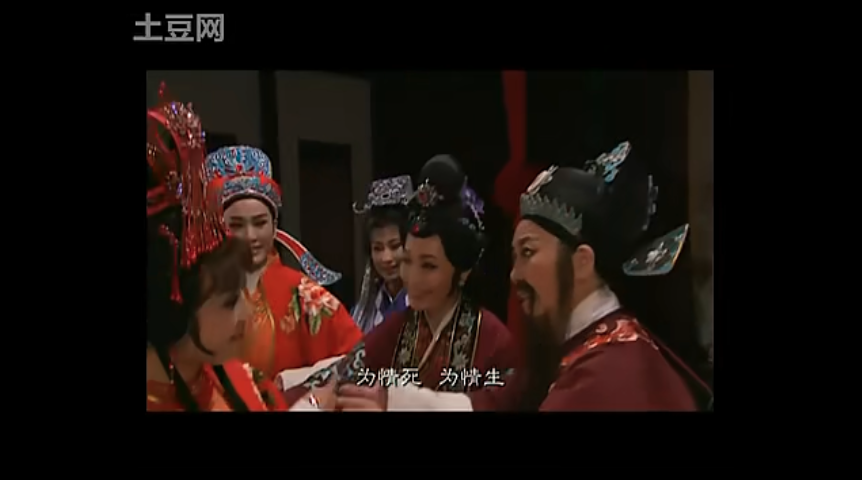
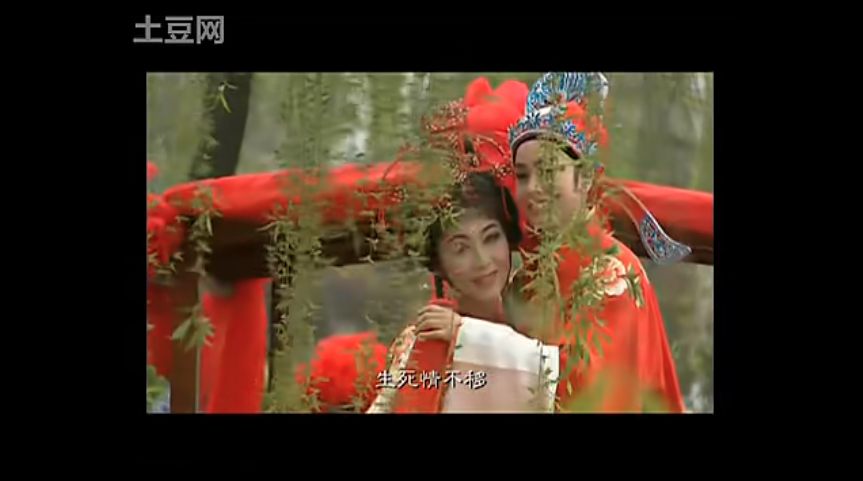
In Tang Xianzu’s original play, Du Liniang and Liu Mengmei marriage was not initially acknowledged by Du’s parents for two reasons. In part, the Dus did not believe the supernatural story of their daughter's resurrection, and in part, they were reluctant to recognize Liu as a son-in-law because Liu he was not a degree holder. By contrast, in the 2009 CCTV Yue Opera adaptation, the resurrected Du Liniang’s marries Liu Mengmei with her parents’ permission at the Du family mansion despite the fact that he has not (yet) passed the civil service examinations (see Fig. 12). The sociopolitical background against which the original play unfolds, and the very real class anxiety associated with examination success, is ignored in favor of a quick romantic happy ending. Qing is thus located almost completely in the reciprocal relation between the two lovers, not in a more complex negotiation of social expectations as in other adaptations.Click to expand/collapse Translation Notes
Chinese Subtitles CTC Translation 旁白:一曲还魂记,流传三百年。 Voiceover: The drama Huanhun ji (The Return of the Soul [at The Peony Pavilion]) has been passed down for three hundred years. 旁白:至诚开金石,生死情不移。 Voiceover: The hardest metal and stone will be broken by the sincerest earnestness; no matter life or death, love remains. Click to expand/collapse Translation Notes
Chinese Subtitles CTC Translation 旁白:为情死,为情生。 Voiceover: [Du Liniang] both dies and is resurrected on account of love. Click to expand/collapse Translation Notes
Chinese Subtitles CTC Translation 生死情不移 Love for which one dies and is resurrected doesn't change. WORKS CONSULTED: CLICK TO EXPAND/COLLAPSE
Tang Xianzu 湯顯祖. Mudan ting 牡丹亭. Beijing: Renmin wenxue, 1963.
Tang, Xianzu. The Peony Pavilion, Mudan ting. Trans. Cyril Birch. 2nd ed. Bloomington: Indiana University Press, 2002.
Lam, Ling Hon. “The Peony Pavilion: Emotions, Dreams, and Spectatorship.” In How to Read Chinese Drama: A Guided Anthology, edited by Patricia Sieber and Regina Llamas, 212-234. New York: Columbia University Press, 2022.
AUTHOR
Wenhao Cruz Guan